Try segregation of duties, SailPoint, or Oracle ERP Cloud access review.
Identity Governance Is Only Part of the Answer.
Govern Access. Govern Compliance. Govern Business Risk.
Most Identity Governance platforms were built to answer one question. Who has access?
But governing identities alone doesn’t reduce audit findings, prevent Segregation of Duties violations, prove compliance, or protect critical business processes.
Illustrative — example segregation-of-duties evaluation
Illustrative — figures from the example evaluation above, not audited SafePaaS metrics
| Approve PO | Pay Invoice | Approve Payment | Approve Journal | Credit Memo | Release Pay Run | |
|---|---|---|---|---|---|---|
| Create PO | Conflict | — | — | — | — | — |
| Enter Invoice | — | Conflict | Conflict | — | — | — |
| Maintain Vendor Master | — | — | Conflict | — | — | Conflict |
| Post Journal | — | — | — | Conflict | — | — |
| Create Customer | — | — | — | — | Conflict | — |
| Maintain Bank Details | — | — | — | — | — | Conflict |
AccessPaaS takes a different approach. It combines identity governance, compliance automation, business controls, audit intelligence, and enterprise risk into a single federated governance platform that helps organizations make better access decisions—and better business decisions.
Because every access decision is a business decision.
It fails because it lacks business context.
Knowing someone has access isn’t enough. Organizations also need to know:
Without business context, organizations are managing identities—not governing risk. Identity governance doesn’t equal compliance, and the difference shows up at audit time.
AccessPaaS connects identity with business processes, financial controls, compliance policies, and enterprise risk so organizations can make access decisions based on business impact, not just directory data.
Business leaders don’t lose sleep wondering who has access.
AccessPaaS helps organizations govern the business behind every identity. That is a completely different conversation.
Identity data answers one of these questions. Business context reaches every one of them:
- Failed audits
- Fraud
- Financial exposure
- Excessive privileges
- Regulatory findings
- Slow business processes
- Rising governance costs
Four outcomes every identity program should deliver.
Stay Continuously Compliant
Compliance should be built into every access decision not left until the next audit.
Organizations reduce manual evidence gathering, shorten audit preparation, strengthen SOX compliance, and demonstrate continuous control effectiveness.
Why identity governance and SOX are different programs →Enable the Business
Governance shouldn’t slow the organization down.
AccessPaaS helps organizations accelerate provisioning, onboard applications faster, support mergers and acquisitions, and adapt to business change without sacrificing governance.
Removing approval bottlenecks without losing control →Reduce Business Risk
Prevent inappropriate access before it reaches production.
Organizations reduce Segregation of Duties conflicts, excessive privileges, financial exposure, and remediation effort while improving confidence in every access decision.
Segregation of Duties in ERP, beyond role names →Lower the Cost of Governance
Modernize governance without replacing existing investments.
Organizations reduce implementation complexity, accelerate deployment, onboard applications faster, and lower the total cost of ownership.
What governance actually costs to run →Most organizations already have identity governance.
What they don’t have is confidence that their access decisions satisfy compliance requirements.
AccessPaaS continuously evaluates access against business policy, financial controls, Segregation of Duties, and regulatory requirements so compliance becomes an outcome of governance not a separate project.
This is the case for continuous controls monitoring after an IGA implementation — and for keeping the access evidence auditors actually ask for ready at all times.
Illustrative — example control-evaluation cadence
Access requests are initiated and evaluated continuously, but evidence is gathered retrospectively against an annual audit cycle. Of 46 requests shown, 3 carry a control exception.
Every access decision should strengthen the business.
Approving access is one of the most important control decisions an organization makes. Every approval affects security, compliance, financial controls, and operational risk.
Instead of reviewing access after users already have it, organizations evaluate business risk before access is granted.
The result is
Governance becomes preventative instead of reactive.
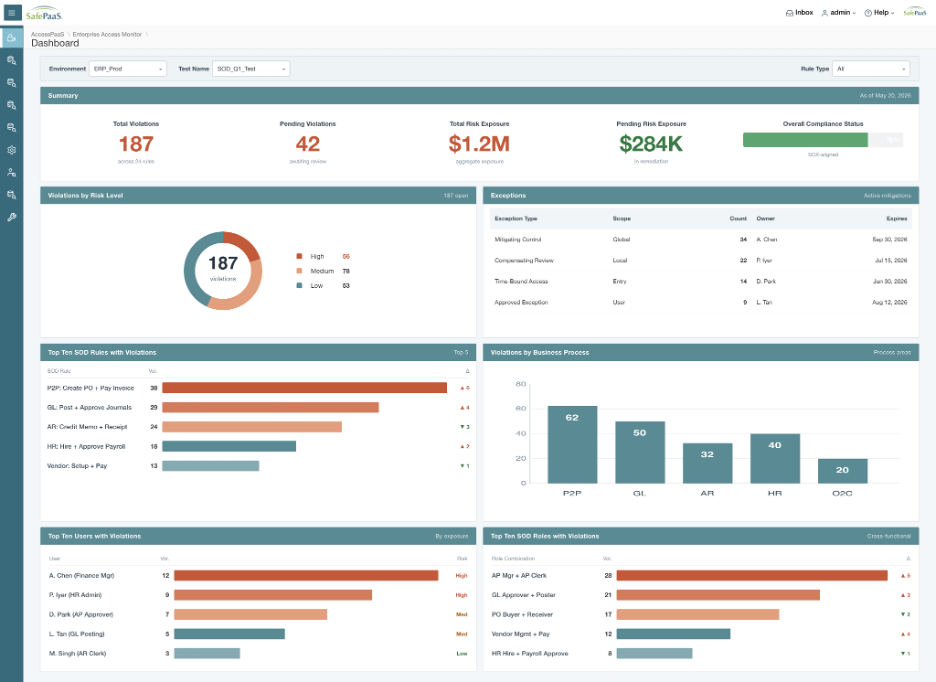 Enterprise Access Monitor — violations ranked by business process and financial exposure.
 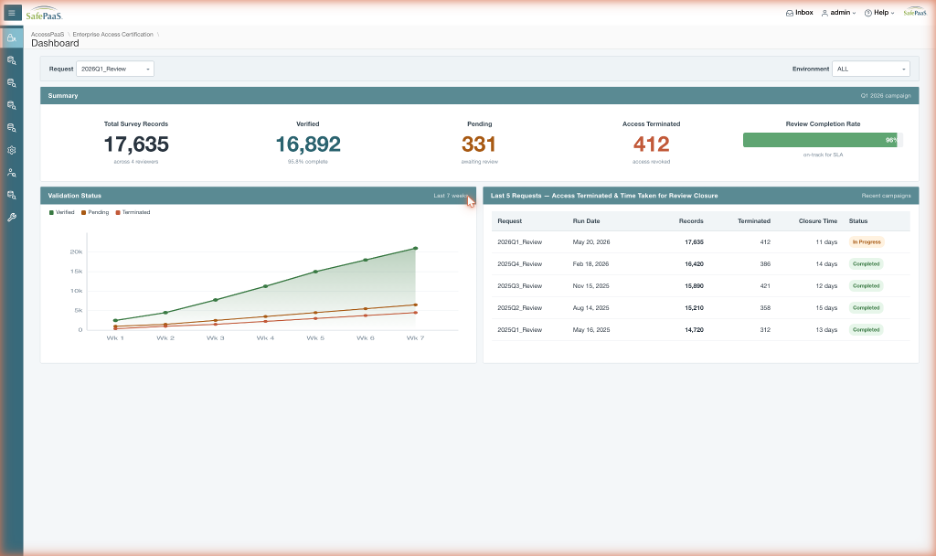 Enterprise Access Certification — completion, closure time and revocations while the campaign runs.
 Traditional Identity Governance understands identities. AccessPaaS understands the business behind every identity.
Instead of asking Who has access? organizations understand what that access allows users to do and the business risk it creates.
That’s how better governance decisions are made.
See how a single ERP responsibility carries business meaning a directory can’t hold.
Illustrative — example access request
It connects identity information with
What a single entitlement means in business terms:
Oracle E-Business Suite —
AP_PAYMENTS_SUPER- Business process
- Procure to Pay
- Financial control
- Payment release
- Approval authority
- Up to $2.4M
- Segregation of Duties
- Conflicts with Vendor Master
- Business impact
- 14 open payment runs
HIGH BUSINESS RISK · routed to control owner
SAP S/4HANA —
ZFI_JE_POST_ALL- Business process
- Record to Report
- Financial control
- Journal posting
- Approval authority
- Unlimited
- Segregation of Duties
- Conflicts with Approve Journal
- Business impact
- Period-end close
BLOCKED · mitigation required
Oracle ERP Cloud —
AR_CREDIT_MEMO_MGR- Business process
- Order to Cash
- Financial control
- Revenue adjustment
- Approval authority
- Up to $150K
- Segregation of Duties
- No conflict
- Business impact
- Within business policy
CLEARED · granted with evidence
Most organizations don’t need another Identity Governance platform. They need governance across everything they already own.
Organizations improve governance without replacing existing identity investments or forcing another enterprise transformation project.
Federated governance vs. centralized identity →Business context reaches every system that grants enterprise access:
Enterprise applications
- Oracle ERP Cloud
- E-Business Suite
- SAP S/4HANA
- NetSuite
Identity and service management
- Workday
- SailPoint
- Okta
- Microsoft Entra ID
- ServiceNow
Cloud, platform and non-human identities
- Salesforce
- AWS
- Service accounts
- AI agents
Identity Governance is only one part of governing enterprise access.
AccessPaaS brings together capabilities that are often spread across multiple tools. Instead of stitching together disconnected products, organizations gain one platform that supports the entire governance lifecycle.
Governing non-human identities is part of that lifecycle too — service accounts and AI agents carry the same business risk as people.
Organizations don’t invest in Identity Governance because they want better user provisioning.
Because successful governance isn’t measured by the number of identities managed. It’s measured by the business outcomes achieved.
They invest because they want to
Reduce audit findings Strengthen financial controls Lower cyber and business risk Improve regulatory compliance Enable business transformation Reduce governance costsAccessPaaS aligns every governance decision to those business outcomes.
Managing identities versus governing risk.
What governance is measured by.
Compliance
Business Enablement
Security
Affordability
Questions buyers ask us first.
Traditional Identity Governance focuses on managing identities and automating access processes. AccessPaaS extends governance beyond identity administration by combining identity governance, business context, compliance automation, Segregation of Duties, audit intelligence, and enterprise risk into a single federated governance platform. Organizations gain the visibility to understand not only who has access, but whether that access is appropriate, compliant, and aligned with business policy.
The full content cluster.
Each of these is also linked from the section of this page it belongs to.
Better business governance is.
AccessPaaS helps organizations use identity as the foundation for stronger compliance, lower business risk, faster operations, and better business decisions.
Govern Access. Govern Compliance. Govern Business Risk.