Policy-based Access

Policy-based Access Control (PBAC)

Right access, right users, right time
Automatically control access with a single policy layer that understands identity, resource, and risk context at every decision—so security, compliance, and scale move together, not in conflict.
All identities. Any application. Any environment.

Proven impact for SafePaaS customers

Broken and weak access controls sit behind a large share of modern breaches, especially as organizations adopt cloud and AI at scale.

1

Around 100% of complex applications tested show some form of access control vulnerability—PBAC is how you close those gaps without rewriting every app.

2

Roughly 80% of breaches involve credential misuse or misused access—policies narrow what attackers can do even when they have a valid login.

3

97% of AI-related breaches stem from missing or weak access controls over AI models and data—PBAC lets you govern prompts, training data, and outputs with the same control model you use for ERP and SaaS.
Why Policy-based Access Controls

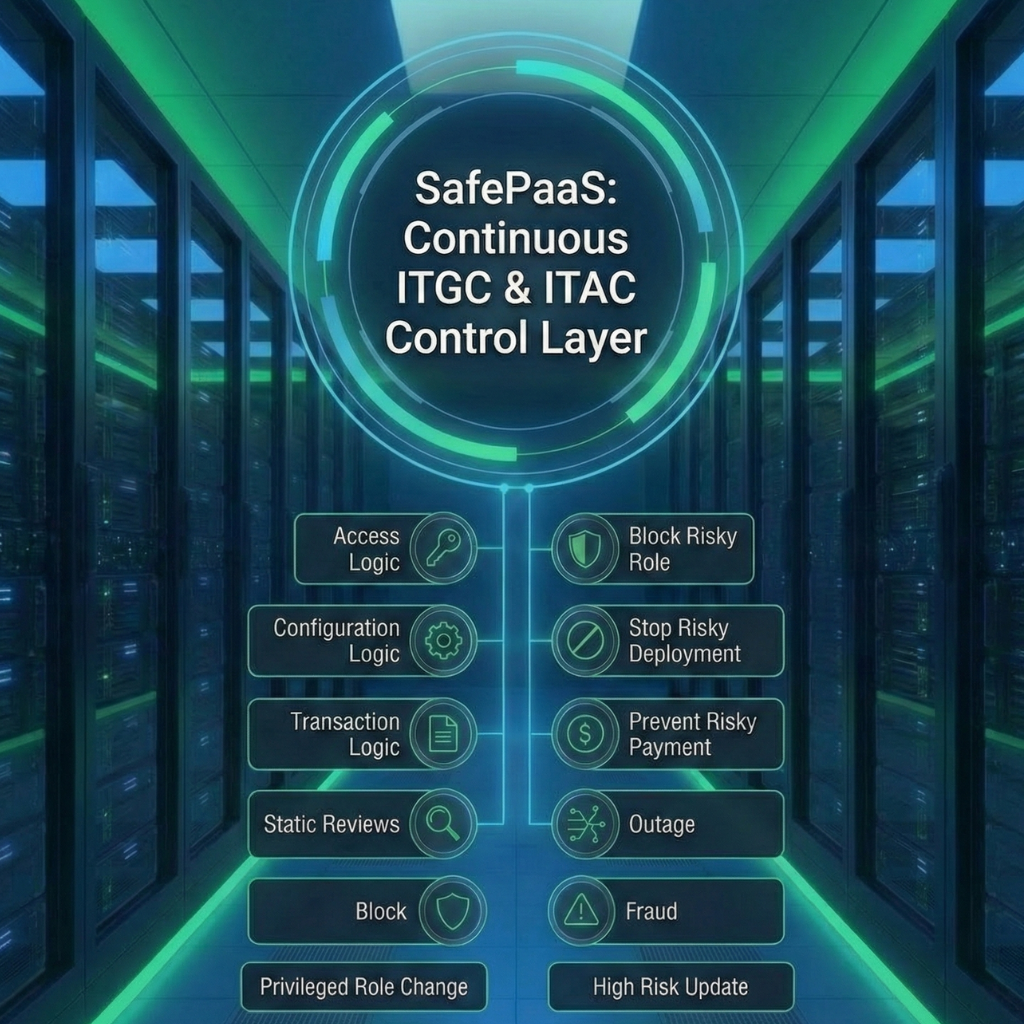
Static, sample‑based reviews and tickets were built for quarterly releases, not daily ERP, SaaS, and AI‑driven change. They leave risky modifications in production until an outage, misstatement, or fraud forces everyone to notice.
SafePaaS adds a continuous ITGC and ITAC control layer that understands access, configuration, and transaction logic and governs them under a single policy model. The same control that blocks a risky role can also stop a risky deployment or payment.
Every privileged role change, configuration update, and high‑risk transaction becomes an auditable event with business context. IT, risk, and audit teams see who changed what, when, why, and how it affected risk—so they can prevent control failures, not just document them.

What makes SafePaaS Unique

Fine-grained, contextual policy model

Fine-grained, policy-based access using identity, resource, and risk context
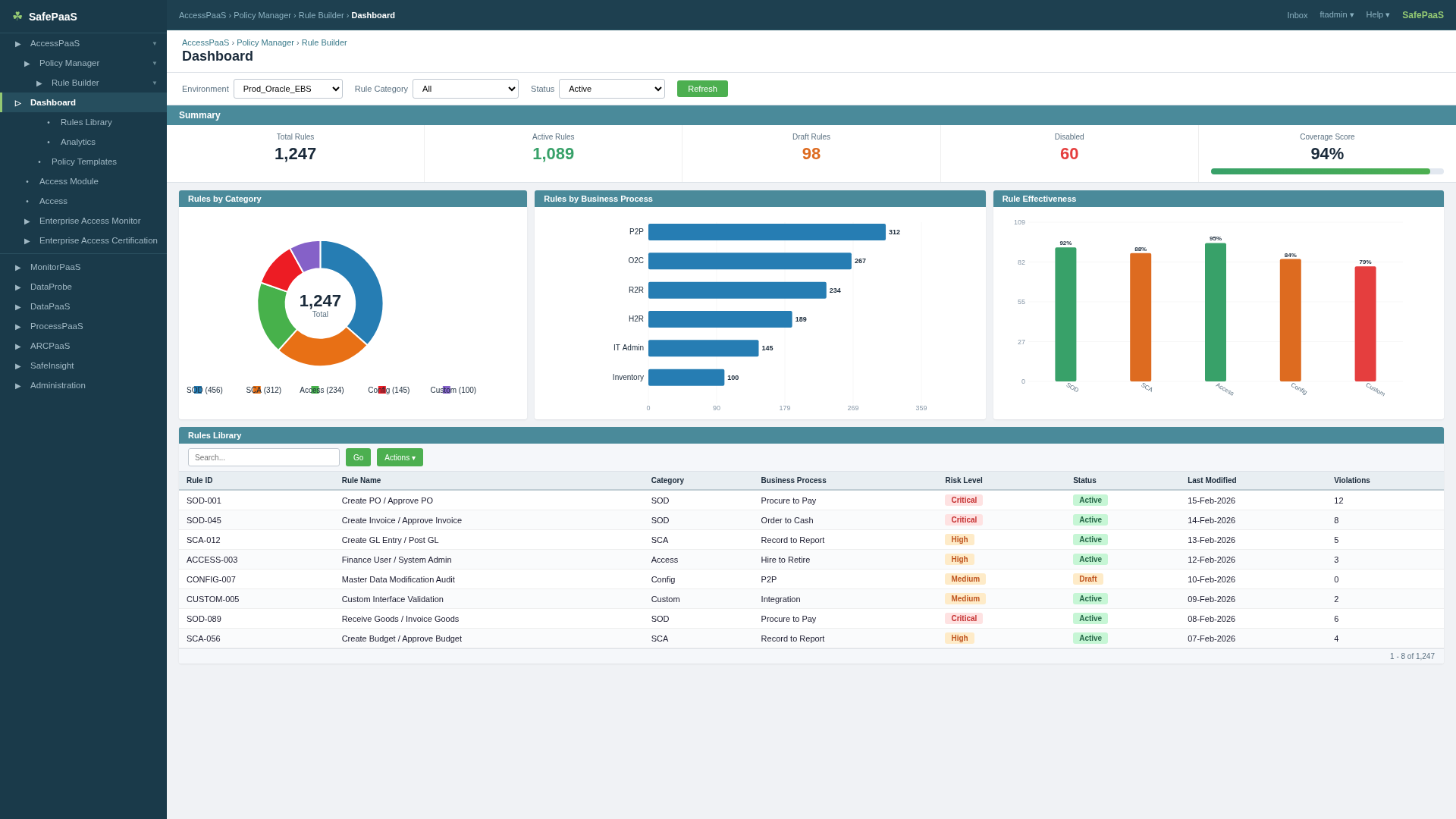
Ability to define who can do what, where, and when, down to the attribute level (role, department, location, device, time, risk score).

Dynamic, context-aware policies
Support for policies that adjust in real time as conditions change, such as risk signals, device posture, or transaction sensitivity.

Centralized governance

Single policy plane across apps, data, APIs, and infrastructure
A single pane of glass to create, update, test, and enforce policies across cloud, on‑prem, SaaS, and APIs.

Policy lifecycle management
Simplified policy versioning, approvals, and impact analysis to reduce human error and streamline audits.

Enforcement and visibility

Real-time policy enforcement at the point of access
Instant enforcement that can deny, step up, or approve access based on policy before unauthorized actions happen.

Continuous monitoring and detailed logging
End‑to‑end visibility and logs for compliance reporting, forensic analysis, and alerting on policy violations.

Integration and automation

Integration with the modern identity and security stack
Seamless integration with IAM, SSO, directories, IGA, ITSM, SIEM/SOAR, and cloud platforms.

API-driven automation
Support for API-driven access controls, enabling automated policy updates, provisioning, de‑provisioning, and workflow orchestration.

Scale and change

Scalable and adaptive architecture
Handles large user bases, high transaction volumes, and complex enterprise environments without performance degradation.

Built for organizational change
Adapts automatically to new applications, mergers and acquisitions, and workforce changes without the need for constant entitlement cleanup projects.

Risk and compliance intelligence

Built-in audit trails and reporting
Audit trails, reporting, and dashboards that align with leading security and risk frameworks.

Insight into high-risk access patterns and policy gaps
Analytics that highlight risky access patterns and potential policy weaknesses so teams can remediate issues before they become incidents.

How SafePaaS customers drive value with PBAC

Leading Latin American Telecom Streamlines Access Governance with SafePaaS PBAC

Industry: Telecommunications

Region: Latin America

Solution: Policy-Based Access Control (PBAC)

Challenges

  • Complex, manual access changes across multiple systems
  • Repetitive entitlement administration consuming IT and security resources
  • Risky standing privileges and inconsistent governance
  • Slow onboarding of new SaaS and AI initiatives, delaying innovation

Solution with SafePaaS PBAC

  • Centralized policy layer across Oracle and other critical systems
  • Fine-grained, context-aware policies to enforce least privilege automatically
  • Automated onboarding for SaaS and AI services
Continuous monitoring and control of high-risk actions and sensitive data

Security and Compliance Benefits

  • Explainable, centralized policies
  • Complete access logs detailing who had access, when, and under what conditions
  • Faster, more predictable audits with reduced dependency on manual evidence

Business Impact

  • Approximately $300,000 eliminated from annual audit preparation and external advisory spend through automated, audit‑ready identity evidence.
  • Double‑digit reduction in identity‑related incidents reaching production by enforcing fine‑grained, policy‑driven controls before deployment.
  • New services and customer offerings are onboarded weeks faster by reusing central PBAC policies instead of rebuilding authorization in each system.
  • Leadership and risk owners gain direct line of sight into high‑risk identities, policies, and actions through unified dashboards and exception reporting.

Key Takeaways

  • Materially reduce identity risk and strengthen overall security posture with centralized, fine‑grained policy enforcement.
  • Turn compliance and audits into repeatable, low‑friction processes with continuous controls and audit‑ready reporting.
  • Automate high‑volume identity tasks (reviews, SoD checks, provisioning) to free operations teams for higher‑value work.
  • Launch and scale new products, channels, and integrations faster by decoupling authorization from individual applications and centralizing it.

According to Gartner, by 2026, 70% of identity-first security strategies will fail unless organizations adopt continuous, context-based access policies — underscoring the limitations of static IAM controls and the need for policy-based approaches.

Business pain points PBAC removes

Policy-based access control consistently delivers value across four core drivers: risk and breach prevention, audit and compliance assurance, operational efficiency, and transformation and innovation.

Risk & breach prevention

  • Minimize insider and external threats by enforcing least privilege and just‑in‑time access.
  • Limit what attackers can do, even when they have valid credentials, by tightly constraining the conditions for sensitive actions.
  • Protect sensitive data and critical systems from unauthorized use, credential abuse, and privilege escalation.

Audit & compliance

  • Automate enforcement of policies aligned with your security and compliance frameworks.
  • Simplify audits and reporting, reducing the time and cost required to prove control effectiveness.
  • Provide clear, explainable policies and evidence that show who had access to what, when, and under which conditions.

Operational efficiency

  • Let policies adapt in real time as employees, roles, applications, or environments change—without manual permissions updates.
  • Reduce administrative overhead for IT and security teams while maintaining strict governance.
  • Replace role clean‑up projects and manual entitlement changes with centralized policy updates.

Transformation & innovation

  • Enable faster adoption of cloud, SaaS, AI, and hybrid environments without compromising security or compliance.
  • Allow new applications, APIs, and AI workloads to inherit existing policies rather than rebuild access models from scratch.
  • Support digital transformation programs with consistent access control across old and new platforms.

Business drivers and pains SafePaaS removes

Centralized identity governance consistently shows value across four core drivers: securing access, passing audits, reducing manual work, and enabling the business.​ 
Driver PBAC capability
Risk & breach prevention Fine-grained, contextual policies that apply least privilege and just-in-time access across applications, data, APIs, and AI.
Audit & compliance Centralized, explainable policies with complete logs and evidence of who had access to what, when, and under which conditions.
Operational efficiency A central policy layer that replaces manual entitlements changes and role clean-up projects with simple policy updates.
Transformation & innovation API-driven enforcement and integrations that let new apps, SaaS, and AI workloads inherit existing policies instead of starting from scratch.

Make policy-based access governance proactive

Protect your business, stay compliant, and move faster by putting access decisions into policies instead of hard‑coded roles. Policy-based access controls prevent breaches, automate regulatory compliance, and streamline access management so your teams can adopt new apps, SaaS, and AI securely—without waiting on manual access changes.