
Oracle EBS Controls and GRC Modernization: The Complete Replacement Guide
For Oracle Applications and ERP leaders replacing legacy Oracle GRC tools, manual controls, or both.
The replacement challenge
How can you replace legacy Oracle GRC or manual controls without losing EBS-specific coverage, interrupting operations, or weakening audit evidence? Preserve the control logic before replacing the process. Map effective access through EBS Responsibilities, Menus, Functions, Concurrent Programs, and organizational scope; retain approved rules and historical evidence; then validate new results alongside existing controls. Retire a process only when its replacement has proved coverage, ownership, remediation, and audit traceability.
The risk in a replacement is easy to miss. An administrator adds a Function to a shared Menu. Which users can now reach it? Does that access conflict with a Concurrent Program available through another Responsibility? Does the answer change by Operating Unit? Who decides whether to remove the access or retain it with a mitigating control, and where will an auditor find that decision six months later?
A Responsibility-level extract cannot answer all of those questions. Neither can a change log or an access-review spreadsheet on its own. Oracle EBS access depends on the underlying Function Security, relevant data security, and application configuration, not just the name of the Responsibility assigned to a user.
Modernization is not a tool swap. It is a controlled transition from disconnected reports and decisions to a repeatable process: identify effective access, evaluate risk, assign ownership, act on the finding, verify the outcome, and preserve the evidence. An existing identity platform or EBS control can remain in place while each replacement component is tested.
Why do EBS controls become hard to sustain?
Most organizations do not set out to build a fragmented control environment. It develops as teams solve individual problems: an extract for periodic Responsibility certification, a SoD report for SOX, an ITSM queue for access changes, and a separate log for configuration changes. Each procedure may work within its original scope. The strain appears when teams need to connect them.
Custom and legacy Responsibility names often give reviewers little indication of the underlying Forms, Functions, Concurrent Programs, or Request Sets. EBS specialists must interpret Menus, exclusions, Request Groups, Profile Options, and security profiles before a business owner can make a sound decision. Approvals and exceptions may sit in email while the access they concern changes in EBS. By the next audit, the team has to reconstruct which population was tested, which rule was in force, and whether a requested removal happened.
Native EBS records remain useful. Oracle documents Sign-On Audit for user activity and AuditTrail for selected changes to application data. But a record that something changed does not, by itself, establish its effect on access, the control owner’s decision, or the verified result. For a closer look at that distinction, see EBS change tracking and configuration governance.
A practical test of the current state is to select one recent high-risk change and ask: Can we show its before-and-after state, affected users, risk assessment, approval, action, and final EBS state without rebuilding the story from several systems?
What must an Oracle GRC replacement preserve?
Start with effective access: what a user can do, how they can do it, and within which relevant organizational scope. Oracle distinguishes Function Security, which governs access to Menus and Functions. A Responsibility name is an important starting point, but it does not describe every capability or restriction beneath it.
Follow the EBS entitlement chain
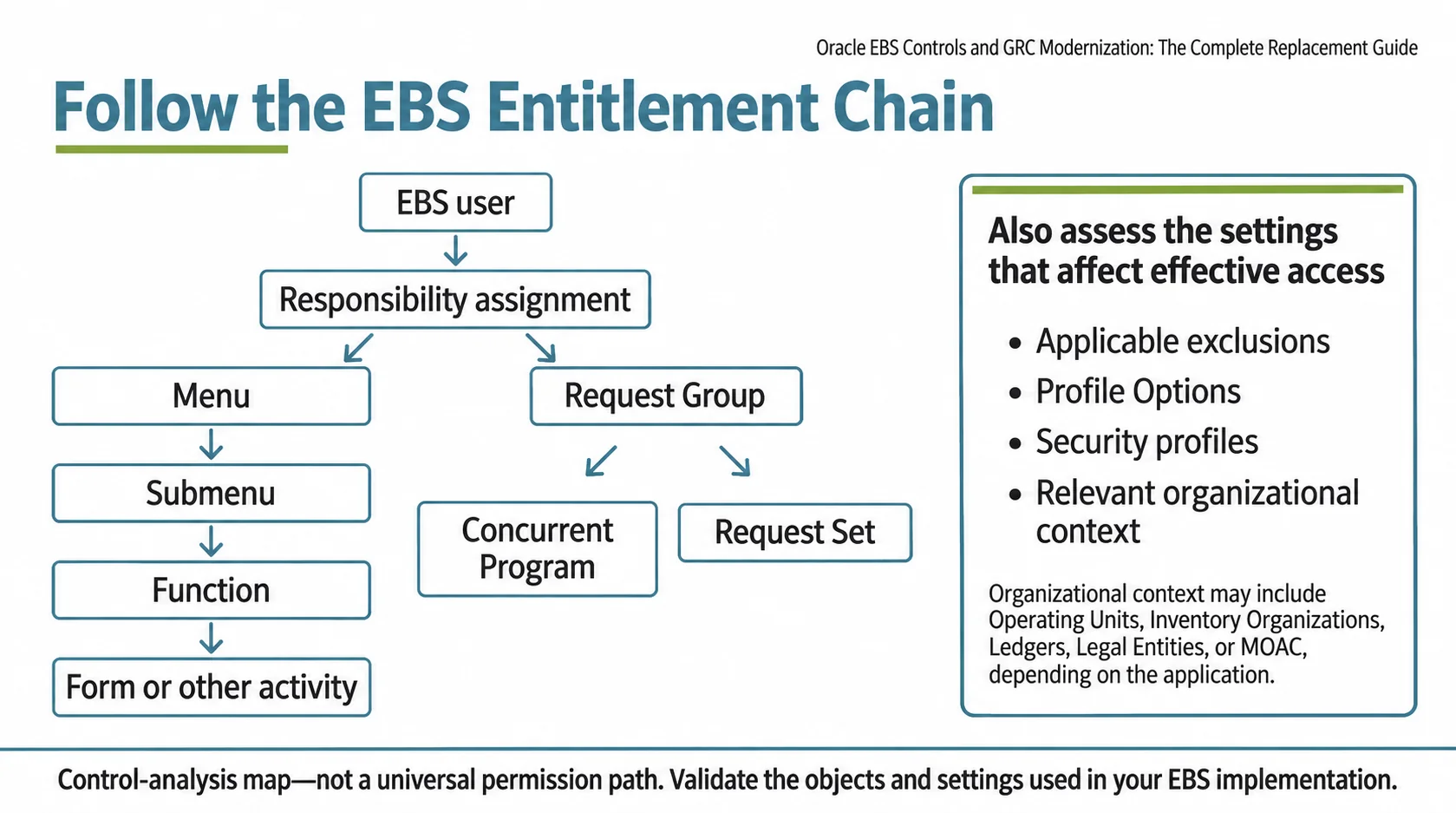
This is a control-analysis map, not a claim that every EBS permission follows an identical path. Test the objects and settings your implementation uses. Depending on the application, organizational context may include Operating Units, Inventory Organizations, Ledgers, Legal Entities, or Multiple Organizations Access Control (MOAC). Two users assigned the same Responsibility may not have the same organizational access. The Oracle EBS SoD and sensitive-access guide goes deeper into the access details that matter to risk analysis.
| Control | EBS detail required |
|---|---|
| SoD analysis | Conflicting Functions or Concurrent Programs available through one or more Responsibilities, assessed in relevant organizational scope |
| Responsibility certification | The assignment, underlying capabilities, business purpose, owner, and scope a reviewer needs to make a decision |
| Privileged access | In-scope use of the SYSADMIN account, System Administrator Responsibility, sensitive administrative Functions, and high-risk Concurrent Programs |
| Change governance | Changes to Responsibilities, Menus, Functions, Request Groups, Profile Options, exclusions, and organizational security |
| Transaction monitoring | In-scope activity or master-data events, distinguished from access a user could exercise |
| Audit evidence | Population tested, rule version, result, reviewer decision, mitigation or remediation, and verification |
Preserve the decisions as carefully as the mappings. Inventory approved SoD rules, mitigating controls, exception criteria, and ownership of standard and custom Responsibilities. Retain the assignment approvals, certification decisions, historical results, and remediation records needed to explain prior periods. A replacement has not succeeded if it generates clearer findings today but makes yesterday’s decisions harder to defend.
Define the target control process
The target is a connected sequence, not a bigger collection of reports:
- Resolve access through the EBS objects and organizational settings relevant to the control.
- Assess proposed Responsibility assignments before provisioning where the workflow permits, and reassess existing access as assignments or configurations change.
- Send a finding to the business owner and control owner with enough detail to make a decision.
- Remove access, approve an exception, or apply a documented mitigating control.
- Verify the resulting EBS state and retain a complete, retrievable record.
Use the same discipline for Responsibility certification, joiner-mover-leaver events, temporary elevated assignments, and shared or integration users. Connect access findings with configuration changes and, where required, transaction monitoring. Potential access and actual activity answer different questions; neither should be presented as proof of the other.
How should you evaluate and migrate?
Put EBS coverage ahead of convenience features. A review workflow may be easy to use, but it cannot support a sound decision if it shows only a Responsibility name when the risk sits in an underlying Function, a high-risk Concurrent Program, or organizational scope.
| Requirement | Priority | Evidence to request |
|---|---|---|
| User-to-Responsibility-to-Menu-to-Function resolution, including relevant Forms and exclusions | Mandatory | Trace sampled users to sensitive activities and reproduce the result. |
| Request Group, Concurrent Program, and Request Set coverage where relevant | Mandatory | Show the effect of a changed Request Group or program on users and rules. |
| Relevant organizational scope | Mandatory | Demonstrate which Operating Unit, Inventory Organization, Ledger, or other scope factors are evaluated—and document limits. |
| Repeatable extraction and reconciliation | Mandatory | Reconcile active EBS accounts and in-scope Responsibility assignments against the source. |
| Rule, exception, and evidence continuity | Mandatory | Map old and new rule meanings and retrieve prior approvals and mitigating controls. |
| Ownership, workflow, and verification | Mandatory | Follow a finding from detection through decision to a verified EBS outcome. |
| Pre-assignment risk analysis | Conditional | Assess a proposed Responsibility assignment before it is made. |
| Configuration and transaction monitoring | Conditional | Demonstrate the specific changes and events required by the control design. |
| Identity, HR, and ITSM integration | Conditional | Trace a request, approval, assignment, risk decision, and evidence record across systems. |
“Conditional” becomes mandatory when your policies or audit scope require it. Give shortlisted providers the same sampled users, Responsibilities, configurations, known findings, and exceptions. Require them to explain disagreements, not just display results.
Run the replacement in phases
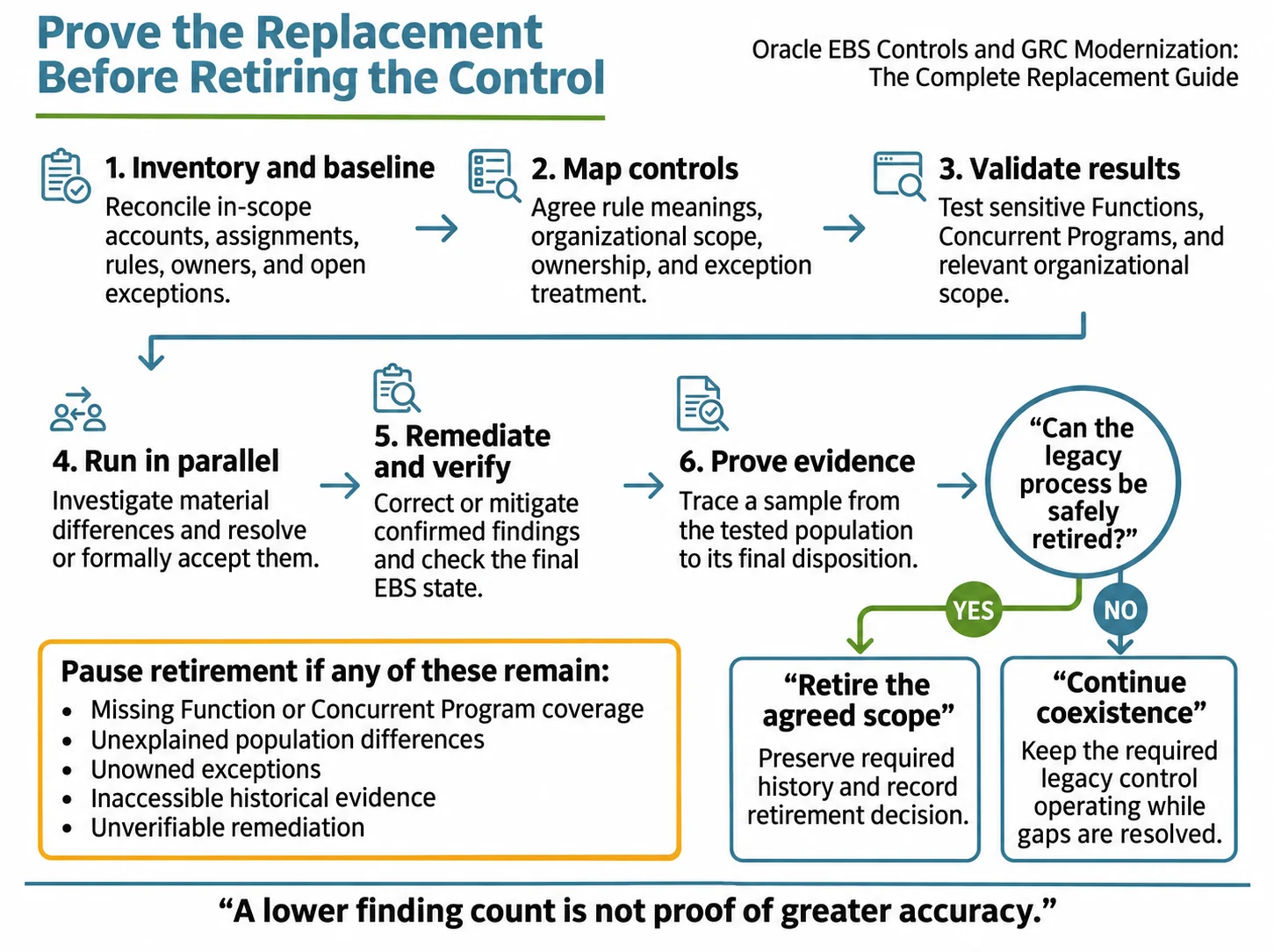
| Phase | Accountable owner | Deliverable and acceptance test | Evidence retained |
|---|---|---|---|
| Inventory and baseline | ERP Director and controls lead | Reconciled population of in-scope accounts, Responsibility assignments, rules, owners, and open exceptions | Scope approval and reconciliation |
| Map controls | Compliance lead and EBS specialist | Each material rule has an agreed definition, owner, scope, and exception treatment | Approved rule map |
| Validate results | EBS specialist and controls testing team | Sensitive Functions, Concurrent Programs, and organizational scope resolve correctly in sampled cases | Test cases and discrepancy log |
| Run in parallel | Control owners | Material differences between old and new processes are resolved or formally accepted | Parallel results and decisions |
| Remediate and verify | Business owners and EBS operations | Confirmed findings are corrected or mitigated; final EBS state is retested | Tickets, approvals, and verification |
| Prove evidence | Compliance and audit stakeholders | A reviewer can follow a sample from tested population to final disposition | Evidence package and sign-off |
| Retire or coexist | ERP Director and process owners | No required control or historical record depends on a process being retired | Retirement decision or coexistence runbook |
Agree on stop gates before the parallel run. Missing Function- or Concurrent Program-level coverage, unexplained population differences, unowned exceptions, inaccessible history, or unverifiable remediation should pause retirement. A lower finding count is not evidence that the new process is more accurate.
For example, if a shared Menu gains a supplier-maintenance Function, the test is not merely whether the change was logged. The process should identify affected Responsibilities and users, evaluate conflicts with payment-processing Functions or Concurrent Programs in the relevant scope, route decisions to the right owners, and verify any correction in EBS.
Measure whether the change works
Establish a baseline for time to tested coverage, time from confirmed risk to verified remediation, completion of Responsibility certifications, effort needed to produce audit evidence, and the number of open or overdue control exceptions. Track confirmed findings that lead to a decision not raw alert volume. These measures show whether the new process improves control operation, not simply whether it produces more reports.
How can SafePaaS support the transition?
SafePaaS connects Oracle EBS access detail with risk analysis, control decisions, and evidence. Its EBS materials describe analysis beneath Responsibility names, including the underlying access that matters to SoD and sensitive-access controls, alongside configuration-change and transaction governance. During evaluation, confirm the precise coverage required by your EBS implementation.
The value during a replacement is continuity from finding to outcome. A team needs to know not only that a user has a potential conflict, but which access creates it, who owns the decision, whether the access was removed or retained with a mitigating control, and how the final state was verified. Test that sequence with your own EBS data rather than relying on a feature checklist.
SafePaaS can work alongside existing Oracle, identity, HR, and ITSM systems. An established workflow may continue to initiate and approve Responsibility assignments, while Oracle-specific analysis checks proposed access for SoD and sensitive-access risk. Recurring analysis can then assess existing access and relevant changes made through other paths. Verify how those handoffs work in your environment and where each approval, mitigation, and remediation record is retained. See SafePaaS for Oracle E-Business Suite for the solution overview.
Ask for two demonstrations using your control rules and sampled EBS data. First, follow a proposed Responsibility assignment through risk analysis, approval, provisioning, and verification. Second, change a Menu or high-risk Concurrent Program and show which users are affected, who reviews the impact, and what evidence remains. These tests reveal whether the new process can replace a legacy control—or should run alongside it until a gap is closed.
A published telecommunications EBS controls case study reports that a SafePaaS customer reduced annual Oracle EBS access-assignment costs from about $120,000 to near zero and had zero findings related to Oracle EBS IT general controls at its SOX review. Those are that customer’s reported results, not a forecast. Build your business case from your own control scope, current effort, and validated gaps.
Next step: Use the Oracle EBS SoD and privileged-access checklist to identify gaps in entitlement coverage, conflict ownership, remediation, and evidence. Then complete an Oracle EBS controls modernization assessment using a representative business process, current rules, a recent change, and an audit evidence request.
Frequently asked questions
Can we replace one control at a time?
Yes. Phased replacement or coexistence is reasonable when each control has a defined scope, owner, acceptance test, evidence location, and retirement decision. Do not switch off a legacy check just because a new tool has started collecting data.
What if the old and new SoD reports disagree?
Compare population dates, active Responsibility assignments, Menu and Function resolution, Concurrent Programs, exclusions, organizational scope, and rule definitions. Classify the difference before accepting either result.
Is an EBS change log enough for audit evidence?
It helps establish what changed and when. For a material control change, retain the impact assessment, decision, action, and verification so a reviewer can reconstruct the outcome.
See governance applied to the access you have today
A working session with a governance specialist — not a slide presentation.
Book your tailored demo