
Start with the financial-reporting processes and systems that matter most, then operate and evidence their controls through repeated cycles before relying on them.
How do we build and prove scalable SOX controls before public-company deadlines and audit scrutiny expose gaps? Start with the financial systems and processes that create the greatest reporting risk and manual burden. Assign accountable owners, define the complete population and required evidence, establish an exception and remediation path, operate controls through repeated cycles, and automate the recurring work that improves traceability, finance capacity, and management visibility.
This guide provides general planning information. Tailor the program to your organization’s risk assessment, reporting environment, and guidance from qualified advisors.
Why IPO preparation exposes control gaps
IPO preparation often overlaps with faster closes, more complex reporting, transaction growth, new entities, system implementations, hiring, investor-readiness work, and advisor requests. The challenge is rarely that a company has no policies or no one performing important reviews. More often, key activities rely on email, spreadsheets, shared folders, manual follow-up, and the knowledge of a small number of experienced employees.
Those practices can work in a smaller environment. They become harder to sustain when finance, IT, internal audit, and process owners need to demonstrate how financial-reporting risks are managed across a growing number of systems, users, changes, transactions, reports, and stakeholders. For a broader introduction to this transition, see SOX preparation for pre-IPO companies.
A scalable control program should be able to answer practical questions:
- Who owns the control and who performs or reviews it?
- Which users, transactions, changes, reports, configurations, or interfaces are in scope?
- How does the team know the population is complete?
- What evidence shows the activity occurred and was reviewed?
- What happens when the control identifies an exception?
- Who owns remediation, and when does management need to intervene?
Once applicable public-company reporting requirements take effect, management is responsible for establishing and maintaining ICFR and reporting its assessment of effectiveness under Section 404(a). A pre-IPO program should prepare for those responsibilities using a risk-based approach tailored to the company’s reporting environment, filing history, and applicable transition period.
See the SEC’s rules on management’s ICFR report and PCAOB AS 2201’s risk-based approach to an ICFR audit.
Build the program in sequence
Teams do not need to perfect every control domain at once. A more practical approach is to establish the operating foundation, focus on the most relevant financial-reporting risks, and mature the program through repeated control cycles.
| Stage | Primary objective | Typical output |
|---|---|---|
| 1. Establish governance | Define sponsorship, decision rights, escalation, accountability, and reporting cadence | Program charter, steering cadence, ownership model |
| 2. Define financial-reporting scope | Identify relevant entities, processes, systems, reports, interfaces, spreadsheets, and service providers | Initial scope and systems/process inventory |
| 3. Establish ITGC foundations | Identify the IT dependencies of in-scope financial-reporting processes, then address relevant access, change management, operations, and data controls | ITGC inventory, owners, evidence requirements, gap backlog |
| 4. Formalize business-process controls | Define controls for close, revenue, procure-to-pay, payroll, treasury, journal entries, reconciliations, and approvals | Procedures, populations, review criteria, control documentation |
| 5. Standardize evidence and certification | Define evidence requirements, retention, sign-off, review traceability, and population support | Evidence standards, retention locations, review workflows |
| 6. Operate and assess controls | Run recurring controls and identify gaps through walkthroughs, testing, or readiness activities as appropriate | Operating evidence, issue log, readiness findings |
| 7. Remediate and automate priority friction | Resolve high-risk gaps and automate repeatable, evidence-heavy work | Remediation plans, automation backlog, pilot initiatives |
| 8. Sustain and improve | Monitor control health, recurring issues, dependencies, and maturity | Management dashboard, escalation routine, improvement roadmap |
A useful operating flow is:
Governance and scope → Control ownership → Repeatable operation → Evidence → Exception handling → Remediation → Management review
If one link is weak, the program may struggle under pressure. A control may be designed well but lack evidence. A review may occur but use an incomplete population. An exception may be identified but have no owner, due date, or closure criteria.
For more detail on the technology, see SOX ITGCs and where to start.
Define the operating model
A policy describes what should happen. A control operating model explains how the organization makes it happen consistently.
| Operating-model element | Key question | Planning guidance |
|---|---|---|
| Risk | What could go wrong, and why does it matter? | Define the risk in clear operational terms and connect it to a process, system, or financial-reporting outcome |
| Control objective | What outcome should the control achieve? | State whether the activity prevents, detects, reviews, or monitors the relevant risk |
| Control owner | Who is accountable? | Identify a role with authority to address gaps and escalate issues |
| Performer and reviewer | Who completes and reviews the activity? | Separate preparer, reviewer, and accountable owner responsibilities where relevant |
| Procedure and cadence | What happens, and when? | Document the actual procedure, frequency, systems, data, decision criteria, and follow-up |
| Population | What is being reviewed or controlled? | Define the complete set of users, transactions, changes, configurations, records, or reports in scope |
| Evidence | What proves performance and review? | Define evidence artifacts, retention location, reviewer traceability, approvals, and population support |
| Exception path | What happens when results do not meet expectations? | Set criteria, assignment, due dates, escalation, and closure expectations |
| Remediation | How is the underlying issue addressed? | Distinguish immediate correction from root-cause remediation or control redesign |
| Oversight | How does management monitor control health? | Define reporting cadence, issue aging, trends, decisions, and escalation paths |
Evidence that an activity occurred is a starting point, not a conclusion that its design or operation was effective. Reviewers also need to consider whether the control addressed the relevant risk, used a complete and accurate population, applied defined criteria, and followed exceptions to resolution.
A repeatable control should establish whether:
- The complete population was included.
- The procedure happened at the required time.
- The reviewer had enough information to make a decision.
- Exceptions were identified using defined criteria.
- Exceptions were assigned and tracked through closure.
- Evidence is available and linked to the activity performed.
- Management can see recurring problems and unresolved dependencies.
A complete control process connects risk, ownership, population, review, and remediation—with evidence retained throughout.
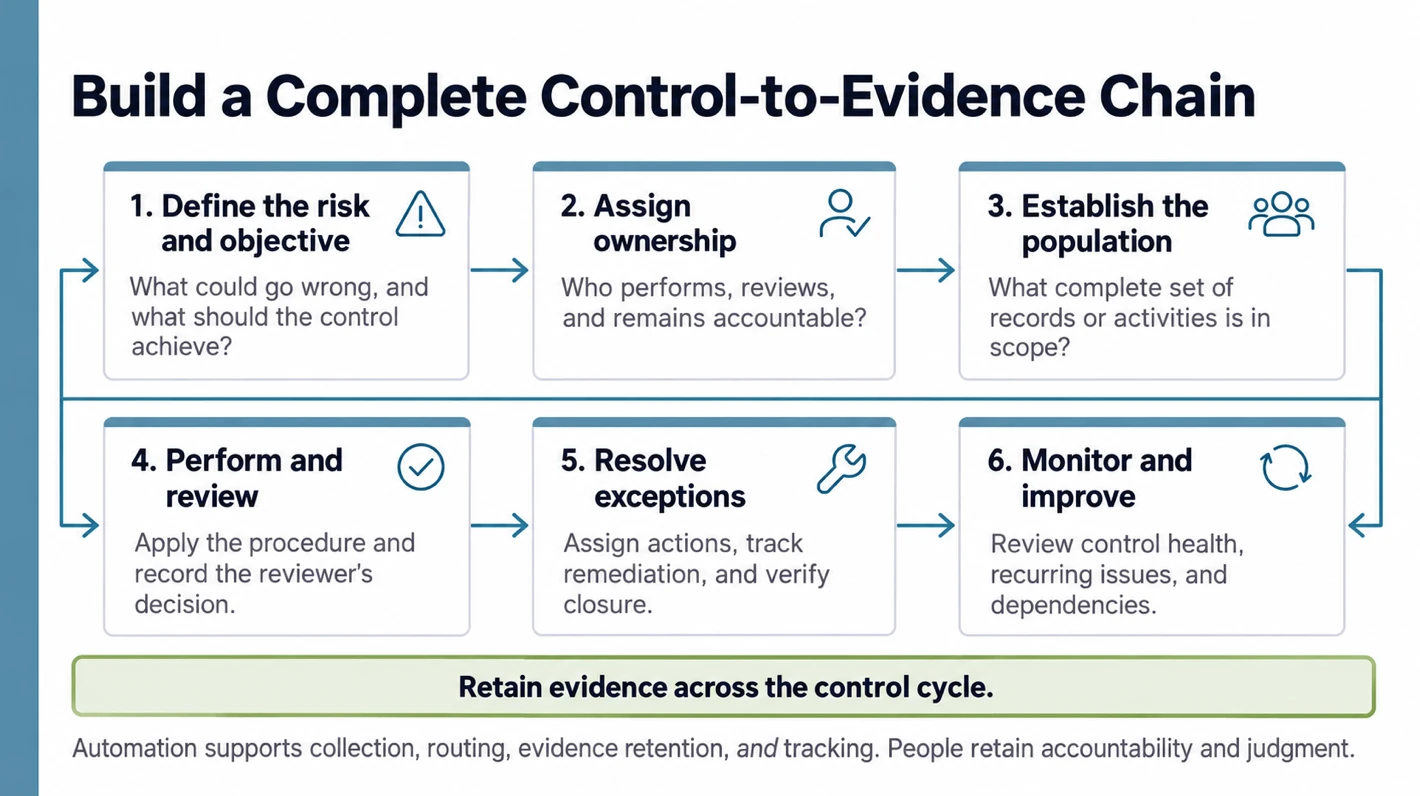
Management owns the design, operation, monitoring, and improvement of controls. When an auditor is engaged to audit ICFR, PCAOB AS 2201 sets out the auditor’s distinct responsibility to obtain evidence and express an opinion on effectiveness. Technology can improve workflow, evidence, and visibility, but it does not itself establish control effectiveness.
Map systems and control priorities
Before selecting automation initiatives, establish a practical view of the financial-reporting environment. The goal is to identify where financial-reporting relevance, operational complexity, evidence burden, and control dependency converge.
| Area | Questions to ask |
|---|---|
| Financial close and reporting | Which systems, reports, reconciliations, journal processes, manual adjustments, and spreadsheets support financial reporting? |
| Revenue | Which systems, interfaces, approvals, data sources, reports, and manual activities affect revenue-related processes? |
| Procure-to-pay | Which vendor, purchasing, approval, payment, master-data, and transaction controls need defined ownership and evidence? |
| Payroll and treasury | Which applications, integrations, access groups, approvals, reviews, bank workflows, and reconciliations require clear accountability? |
| ERP and financial applications | Which systems create, process, approve, configure, store, or report financially relevant information? |
| Interfaces and data flows | Where does data move between systems, and how are completeness, errors, failures, and ownership handled? |
| Reports and spreadsheets | Which reports and end-user computing tools support key controls, and how are completeness, changes, access, and review managed? |
| Service organizations | Which external providers support financially relevant processes, and what responsibilities remain with internal teams? |
For example, an access review may affect a financially relevant application, but the real challenge may be broader than the review itself. The team may need to obtain a complete user population, identify privileged accounts, assign qualified reviewers, capture decisions, track exceptions, verify removals, and retain evidence. That is a control operation—not simply a report.
Early planning should distinguish IT dependencies such as user access, privileged access, and change management from business-process and application controls over transactions, approvals, configurations, interfaces, reports, and spreadsheets. Segregation-of-duties risks may span both access design and financially relevant business activities.
Related resources: SOX ITGCs · SOX segregation of duties · Change management and ITGCs · IT application controls and automation · Automating audit testing
Prioritize high-friction automation
Automation should follow process definition, not replace it. First establish who owns the control, what population is in scope, what evidence is required, how exceptions move to closure, and what management needs to see.
Automation is usually most valuable when it improves repeatability, timeliness, traceability, evidence quality, or finance-team capacity in a defined process.
| Criterion | High score means |
|---|---|
| Financial-reporting relevance | The activity directly affects financial reporting or a key ICFR dependency |
| Risk exposure | Errors, unauthorized activity, missed reviews, or control failures could have meaningful consequences |
| Volume | The process includes many users, transactions, changes, reports, or exceptions |
| Repeatability | The activity follows a recurring and consistent pattern |
| Evidence burden | Teams spend significant time gathering, organizing, validating, or retaining support |
| Population complexity | Reviewers combine multiple sources or struggle to confirm completeness |
| Exception frequency | Exceptions recur or remain difficult to assign and close |
| Manual handoffs | Work depends on email, spreadsheets, local files, or individual knowledge |
| Implementation feasibility | Ownership, process design, data, and dependencies are sufficiently clear |
Score each criterion from 1–5 to compare improvement opportunities. Review the scores alongside reporting risk, observed control gaps, and urgent issues; a high combined score is neither a formal risk rating nor a finding that a control is effective or ineffective. Use the readiness assessment below to record unknowns and urgent flags separately.
| Automation outcome | Examples |
|---|---|
| Improve population completeness and review execution | User-access reviews, privileged-access reviews, segregation-of-duties workflows, joiner-mover-leaver processes, recurring transaction reviews, reconciliations |
| Standardize evidence and certification | Access-request approvals, control sign-offs, reviewer certifications, change-control evidence, evidence collection, report-review support |
| Track exceptions and remediation | Access exceptions, SoD conflicts, overdue evidence, remediation actions, repeat issues, management escalation |
The right candidate is not necessarily the most visible control. It is often the activity where reporting risk, recurring manual effort, evidence burden, and implementation feasibility overlap. For additional context on controls embedded in financial applications, see IT application controls and the benefits of automation.
Use automation to protect finance capacity
During IPO preparation, finance teams may be managing faster closes, expanded reporting requirements, advisor requests, transaction growth, system changes, control documentation, and recurring operational reviews at the same time.
The value of automation is not simply fewer manual tasks. It is creating capacity to complete reviews, investigate exceptions, retain evidence, and address root causes without relying on last-minute evidence reconstruction. See also how audit leaders are automating testing and reducing cycle times.
Automation can help teams:
- Collect and validate user, transaction, change, or report populations.
- Route access requests, certifications, reviews, and approvals.
- Retain evidence of decisions, timestamps, comments, and approvals.
- Track exceptions, remediation actions, owners, and due dates.
- Monitor incomplete reviews, overdue evidence, and recurring issues.
Automation does not replace judgment. People still need to review unusual transactions, investigate root causes, make risk decisions, approve remediation, and monitor control health.
Include service organizations early
If a service provider supports financially relevant processing, include that dependency in the controls roadmap. PCAOB AS 2601 addresses an auditor’s consideration of a company’s use of a service organization. The practical question is not simply whether a SOC 1 report exists; teams also need to understand what the provider does and which controls remain their own responsibility.
Identify:
- Which financial-reporting processes depend on the provider.
- Which controls the service organization performs.
- Which complementary user entity controls remain the company’s responsibility.
- Who reviews the report and tracks relevant findings or exceptions.
- What evidence demonstrates that required internal responsibilities were completed.
The treatment of service-provider reports and complementary user entity controls depends on the organization’s circumstances and should be addressed with appropriate advisors.
Build the roadmap by time horizon
There is no universal IPO readiness timetable. The appropriate sequence depends on reporting complexity, systems, organizational change, financing and transaction plans, available resources, and control maturity.
For an in-depth guide, see Pre-IPO SOX Readiness starts before the roadshow.
These phases are planning horizons, not statutory deadlines. Under the SEC’s transition rules, a newly public company generally does not include management’s Section 404(a) ICFR assessment or an auditor’s Section 404(b) attestation in its first annual report; the first report must explain the omission. The transition may differ for a company that was already an Exchange Act reporting company. Emerging growth companies are exempt from Section 404(b) attestation while they qualify, but that exemption does not itself remove applicable management responsibilities. Confirm the company’s filing history, status, and reporting dates with securities counsel and accounting advisor.
12–18 months or earlier: Establish the baseline
- Establish executive sponsorship and cross-functional governance.
- Identify priority processes, systems, applications, interfaces, reports, spreadsheets, and service dependencies.
- Develop an initial risk and control inventory.
- Define process, control, IT, evidence, and remediation owners.
- Set documentation and evidence standards.
- Identify high-friction manual activities and the first automation priorities.
By the end of this phase: leadership has agreed on initial scope and governance, priority workstreams have accountable owners, and the organization has a documented view of significant systems, dependencies, and control gaps.
6–12 months: Operate priority controls and reduce friction
- Refine procedures, ownership, review criteria, and evidence requirements.
- Establish retention locations and review or certification workflows.
- Improve priority access, change, transaction, evidence, and remediation processes.
- Begin recurring control operation and issue tracking.
- Perform walkthroughs or readiness reviews as appropriate.
- Implement selected automation initiatives when ownership, data, dependencies, and acceptance criteria are ready.
By the end of this phase: priority controls operate on their intended cadence, evidence practices are used consistently, exceptions have owners and due dates, and management can see incomplete activity, evidence gaps, open issues, and dependencies.
Final two quarters: Stabilize and improve
- Confirm priority control execution over repeated cycles.
- Monitor overdue evidence, incomplete reviews, unresolved exceptions, and remediation aging.
- Refine management reporting and escalation routines.
- Conduct targeted testing, re-performance, walkthroughs, or readiness activities as directed by the organization and its advisors.
- Document key dependencies, decisions, accepted risks, and remaining maturity priorities.
By the end of this phase: management has a clear view of control health and unresolved risks, evidence is organized and linked to recurring activity, and significant remediation actions have clear ownership and escalation paths.
Measure control health and choose priorities
Management needs a concise view of whether priority controls are operating, evidence is complete, issues are aging, and dependencies require action.
| Metric | What it indicates |
|---|---|
| Control completion rate | Whether recurring activities are performed on schedule |
| Overdue evidence | Whether teams are struggling to collect or retain required support |
| Incomplete reviews | Whether assigned reviewers completed required decisions and follow-up |
| Open exceptions by severity | The volume and seriousness of unresolved operational issues |
| Open significant control issues | Whether issues requiring management attention are being evaluated, remediated, and escalated |
| Remediation aging | Whether corrective actions are progressing and closing |
| Repeat issues and major dependencies | Whether root causes remain unresolved or systems, staffing, policy, or third-party dependencies require action |
For organizations that report controls information to the audit committee, agree with leadership and advisors on a concise reporting package covering completion, significant issues, remediation aging, repeat findings, key dependencies, and decisions requiring escalation.
Readiness exercise: Select the first three priorities
Example:
| Priority | Control domain | Why now | Accountable owner | Main dependency | First 30-day action | 60–90-day success measure |
|---|---|---|---|---|---|---|
| Priority 1 | [Complete] | [Complete] | [Complete] | [Complete] | [Complete] | [Complete] |
| Priority 2 | [Complete] | [Complete] | [Complete] | [Complete] | [Complete] | [Complete] |
| Priority 3 | [Complete] | [Complete] | [Complete] | [Complete] | [Complete] | [Complete] |
Next step
A pre-IPO controls program becomes more manageable when the organization starts with operating reality: the systems, processes, people, evidence, exceptions, and remediation work already taking place.
Start with the highest-risk and highest-friction activities. Define ownership. Establish a control-to-evidence chain. Improve the processes that create the greatest manual burden or visibility gap. Then use automation where it strengthens repeatability, traceability, workflow, finance capacity, and management oversight.
Complete the pre-IPO controls readiness assessment to identify the first three automation candidates. Then use the results to prioritize the relevant system-specific controls guide and build a sequenced remediation plan. For additional preparation guidance, see SOX Preparation for Pre-IPO Companies.
Frequently asked questions
Preparing for an IPO requires companies to establish effective internal controls over financial reporting (ICFR), document control processes, and demonstrate that key risks are appropriately managed. SafePaaS helps pre-IPO companies strengthen their control environment by providing visibility into user access, segregation of duties (SoD), and application controls across critical business systems. By identifying control gaps earlier, companies can prioritize remediation, improve audit readiness, and build a stronger foundation for SOX compliance before going public.
As companies prepare for an IPO, growing teams, complex application environments, and evolving responsibilities can introduce access risks and segregation of duties conflicts that may undermine internal controls. SafePaaS helps organizations identify excessive or inappropriate access, detect SoD conflicts, and monitor access risks across business-critical applications. By providing continuous visibility into these risks and supporting structured remediation workflows, SafePaaS helps companies address potential control weaknesses before they become significant challenges during SOX assessments or external audits.
SOX readiness is not a one-time exercise. Companies need sustainable controls that can evolve as the business grows and regulatory expectations increase. SafePaaS supports this by centralizing access governance, SoD risk management, and control monitoring, helping organizations establish repeatable processes and maintain evidence of control activities. This enables finance, IT, and internal audit teams to improve oversight, reduce reliance on manual reviews, and build a more scalable control environment that supports ongoing SOX compliance as the company transitions into life as a public company.
There is no universal start date. However, 18-24 months out provides the ideal runway. (See pre-IPO SOX Readiness Guide.)
Activities are often good candidates when they are financially relevant and also high-volume, repeatable, evidence-heavy, difficult to track manually, or affected by recurring exceptions. Examples may include access reviews, access-request workflows, evidence collection, certifications, remediation tracking, change-control evidence, and structured transaction reviews.
No. Automation can standardize data collection, workflow, notifications, evidence retention, tracking, and reporting. Accountable people still need to make decisions, complete reviews, evaluate exceptions, oversee remediation, and monitor control health.
Identify the financially relevant service relationship, the controls performed by the provider, the complementary internal controls your organization must operate, the owner responsible for review, and the evidence needed to show required internal activities were completed.