
The Cost of Maintaining Oracle Fusion Roles
What does it really cost to keep Oracle Fusion roles usable, compliant, supportable, and aligned with business change? The cost extends beyond designing Job Roles. It includes assessing access requests, approving and testing changes, checking SoD conflicts, responding to quarterly updates, resolving access issues, and producing evidence. To calculate it, measure how frequently that work occurs, who performs it, how long it takes, and how much rework it creates.
A role catalog cannot answer that question on its own. It shows what the team maintains, but not the work required to keep access appropriate. This guide helps you establish that operating cost, identify where effort accumulates, and decide which steps deserve attention first.
Why does role maintenance cost more than role design?
A Job Role name does not show an approver everything a user can do. Job Roles can inherit Duty Roles and Privileges; Duty Roles can also inherit other Duty Roles or aggregate privileges. Data Access assignments determine the organizational scope available for relevant functions. Assigning a role that permits payables work and granting access to a particular Business Unit’s data are distinct decisions.
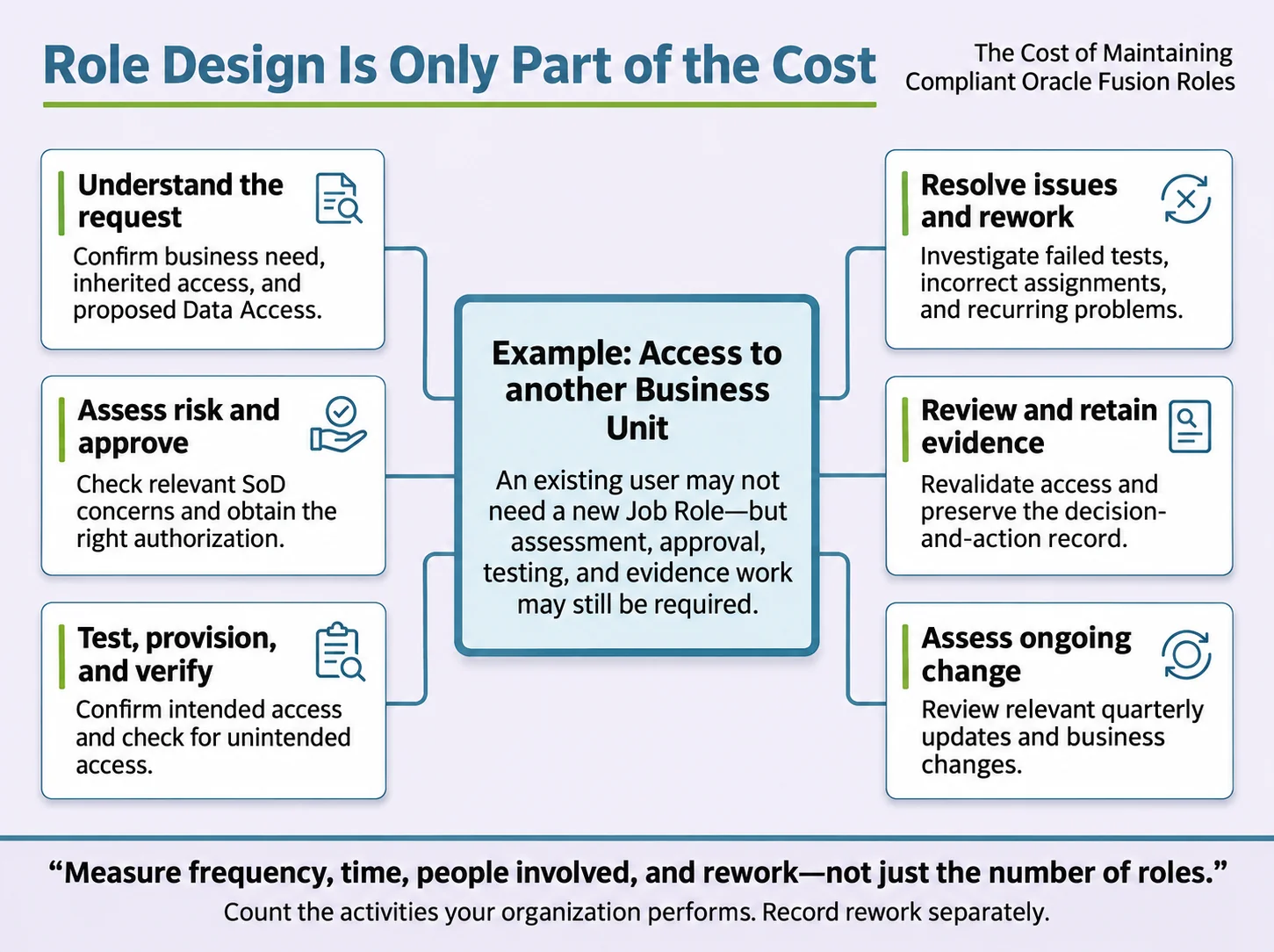
Consider an accounts payable user who needs access to another Business Unit. The team might not need to create or change a Job Role. It still needs to confirm the business need, assess the user’s effective access, check whether the proposed scope affects an SoD concern, obtain approval, make the Data Access assignment, test the result, and retain evidence. Counting only role-build hours misses the work generated by that request.
Business change keeps this process moving. Reorganizations, new modules, integrations, acquisitions, personnel moves, and custom changes or copied Job Roles create new access decisions. Each quarterly update also creates a checkpoint to assess relevant delivered security changes, enabled functionality, customer configurations, and existing control assumptions. An update does not automatically change every role; the work is determining what needs review. For a broader view of the control questions after implementation, see Beyond Go-Live: How to Keep Risk from Creeping into Oracle ERP Cloud.
Where do the hours accumulate?
Follow a request from initial assessment to periodic review. For the Business Unit example, the activity starts when someone asks for access and ends after the assignment works as intended and the decision can be supported later.
| Activity | Work to count |
|---|---|
| Request and assessment | Clarify the business need, affected users, Job Roles, inherited access, and proposed Data Access |
| Ownership and approval | Identify who can authorize the access and record the decision |
| SoD and control review | Assess relevant Privileges and whether organizational scope affects a potential conflict |
| Business and security testing | Confirm the user can complete the intended task without receiving unintended access |
| Provisioning and verification | Make the approved assignment and check the result |
| Remediation and support | Investigate failed tests, incorrect assignments, recurring conflicts, or access-related tickets |
| Certification and evidence | Review continuing access and retrieve the request, approval, SoD result, mitigation, and remediation history |
| Quarterly-update assessment | Check whether relevant security changes or configurations affect existing access and controls |
Not every request passes through every step. Count the work your organization performs, and record rework separately so the original assessment or test is not counted twice.
Licensing analysis can add another cost category, but it needs its own review. Oracle publishes metric descriptions for Fusion offerings and Fusion service descriptions. Reducing the number of Job Roles does not automatically reduce licensing cost. Assess any suspected entitlement issue against your organization’s applicable Oracle agreement and order documents with a licensing specialist.
Which improvements should you prioritize?
Start with the activities that combine high effort, repeated rework, and a control problem. The right response depends on what your worksheet reveals.
| If you find… | Investigate… |
|---|---|
| Repeated redesign of copied Job Roles | Whether clearer design standards and ownership would prevent recurring changes |
| Remediation after access is provisioned | Whether proposed Job Role and Data Access changes can be assessed before provisioning |
| Recurring SoD conflicts | Whether reviewers have enough detail about inherited Privileges and organizational scope to make the right decision |
| Slow certifications | Whether reviewers can see more than the top-level Job Role name and understand the business impact of access |
| Time spent rebuilding audit evidence | Whether approvals, SoD results, mitigation, and remediation decisions can be captured as the work happens |
| Failed tests after quarterly updates | Whether security-impact assessment should supplement functional regression testing |
Take the Business Unit request through that test. If most effort sits in finding the right approver, improve ownership. If the team spends its time investigating a conflict after provisioning, examine preventive analysis. If the work is complete but the decision has to be reconstructed for audit, improve how evidence is captured.
For a closer look at conflict review and corrective action in an Oracle ERP Cloud project, see this SafePaaS SoD case study. It describes the steps taken; use your own worksheet, rather than another organization’s results, to estimate your potential benefit.
How does SafePaaS fit the cost findings?
The worksheet can reveal that making an access assignment is straightforward while deciding whether it is appropriate takes substantial effort. A reviewer needs to understand what a Job Role inherits, how Data Access changes the user’s scope, whether the combination creates an SoD concern, and how the decision will be evidenced. When that context is spread across Fusion extracts, identity workflows, tickets, emails, and spreadsheets, teams have to assemble it again for the next request or review.
SafePaaS connects identity workflow with Oracle-specific access-risk governance and SOX control evidence. It is designed to give reviewers visibility below top-level Job Role names, support analysis before access is provisioned, and keep decisions about mitigation, remediation, and evidence connected to the access under review. For detail on role-design simulation and connecting Oracle Cloud access with identity and service-management workflows, see the Risk and Controls for Oracle ERP Cloud discussion. For a closer look at how SafePaaS describes effective-access analysis and linked mitigating controls, see its capability deep dive.
The business case should stay tied to measured work. Compare the current process with the proposed one, identify the steps that would change, and validate any product or savings claim before publication. SafePaaS does not replace accountable role owners, sound Job Role design, or specialist review of Oracle licensing terms.
Learn about License controls that help prevent cost overruns
See governance applied to the access you have today
A working session with a governance specialist — not a slide presentation.
Book your tailored demo