SailPoint Coverage Proof-of-Value Guide
Your SailPoint program may be working as designed and still leave important questions unanswered in a critical application. Can a reviewer see what a person can actually do? Can a business owner evaluate a conflict, remove inappropriate access, and show an auditor that the change took effect?
A coverage proof of value tests those questions in a defined application—not across your entire estate. It compares the governance outcomes your current deployment produces with the outcomes your business needs, using agreed data, scenarios, owners, and acceptance criteria. The result should tell you whether to improve the existing setup, change a process, add application-level governance, or take no further action.
By the end of this guide, you should be able to scope one application-level POV, agree on what would count as proof, and give leadership a clear recommendation—whether or not that recommendation involves SafePaaS.
When is a coverage POV useful?
Run a proof of value when a high-risk application is technically connected to your IGA program, but IAM, application owners, or auditors still rely on manual work to understand access or close findings. The broader SailPoint Value Gap guide explains how to identify where expected governance outcomes and day-to-day coverage diverge; this guide takes the next step by testing one application.
Typical triggers include:
● Reviewers can see an account or role but cannot tell what its underlying privileges permit.
● Business owners cannot readily identify conflicts across the access a user has accumulated.
● A certification records a revoke decision, but the team must investigate whether access was removed in the application.
● Audit evidence shows that a review happened but does not clearly connect the finding, decision, action, and final access state.
● Different teams disagree about whether the gap is in data, configuration, ownership, process, or tooling.
If you are still deciding which symptoms warrant investigation, start with the five warning signs of SailPoint compliance gaps. None of these symptoms, by itself, proves that SailPoint lacks a capability. They show why a test of your implemented coverage is more useful than a broad platform comparison.
Before you commit to a test
A useful POV needs more than access to a demo environment. Confirm that the organization can provide:
● An approved application and SailPoint data extract for the same population and time period.
● A way to map identities to application accounts, roles, and relevant entitlements.
● Security approval for how the data will be accessed, processed, retained, and removed.
● An application specialist who can explain what the selected privileges permit.
● Business and control owners who can validate findings and decide what requires action.
● An agreed approach to remediation, including whether production changes are allowed.
● Time from IAM, the application team, security, and audit to review results and resolve disputes.
If a prerequisite is unavailable, narrow the scope or record the affected test as not run. Do not present an untested outcome as either a pass or a product failure.
What decision should the POV make possible?
Set out the possible decisions before testing begins. Otherwise, the exercise can turn into a demonstration of whichever result a team expected to find.
| Decision path | What the POV would need to show |
|---|---|
| Improve the current SailPoint deployment | The required outcome is achievable with better data, configuration, access modeling, or use of existing capabilities. |
| Change the operating process | The technology provides sufficient information, but ownership, approvals, escalation, or follow-through are weak. |
| Add application-level governance | A material control need remains unmet within the tested scope, and an added capability demonstrably closes it. |
| Phase further testing | The first application reveals a useful approach, but additional systems or populations must be tested before a broader decision. |
| Make no change | The current approach meets the agreed control and evidence requirements. |
SafePaaS should enter this decision as a testable option, not a predetermined answer. The question is whether application-level access and control context improves decisions that currently depend on manual extracts or specialist knowledge—and whether those decisions can be carried through to an evidenced outcome.
If the test identifies a requirement the current deployment cannot meet, use How to Choose an IGA Platform That Supports Remediation to assess the available options. The specific SafePaaS integration approach and delivery boundaries must be confirmed for the customer’s environment before the POV begins.
How do you choose the right scope?
Choose one application that matters enough to support a decision but is small enough to test properly. An ERP system involved in financial approvals might be a good candidate if its relevant owners and data are available.
Define the boundary before requesting extracts:
● Application: The system, environment, and business process being tested.
● Population: Included users, accounts, service accounts, business units, and relevant access types.
● Risk questions: The sensitive privileges, segregation of duties (SoD) conflicts, lifecycle changes, or audit controls that matter.
● Time period: A frozen point in time or agreed test window for comparative analysis.
● Exclusions: Access, workflows, integrations, and historical periods the test will not cover.
● Decision owner: The person or group authorized to act on the readout.
For example, a team could test whether it can identify who has access to both create and approve a payment in one ERP application. That is more useful than asking whether the application is “covered.” It requires the team to understand the privileges, assess the potential conflict, assign an owner, reach a decision, and verify any approved change.
What should you test side by side?
Start with a baseline of what SailPoint and the existing operating process already provide. Then use the same population, period, and control questions to assess whether a proposed addition produces a meaningful improvement. Record the configuration and manual analysis needed on either side.
| Test scenario | What to examine | What a useful result looks like |
|---|---|---|
| Inherited access | Can a reviewer trace access from the identity through roles or assignments to relevant privileges? | The reviewer can understand the access without relying solely on an application specialist’s interpretation. |
| Existing SoD conflict | Can the team identify and assess a defined combination of business privileges? | A business owner can distinguish an actionable conflict from a technical match or accepted exception. |
| Request-time conflict | What happens when a user requests access that would create the defined conflict? | The risk is evaluated at the agreed point in the request process and routed to the right decision-maker. |
| Mover accumulation | What access remains after a person changes role or department? | The team can identify potentially unnecessary access and explain who should decide on it. |
| Service account ownership | Who owns a selected non-human account and its access? | An accountable owner can review and explain its purpose and privileges. |
| Remediation and verification | What happens after an owner decides to remove access? | The team can trace the decision through action to a checked source-system state—or state clearly where that chain stops. |
Include cases that should not generate a finding. If every case is designed to produce a violation, the POV cannot show how well it handles false positives or legitimate exceptions.
Three SafePaaS hypotheses to test
Rather than asking whether SafePaaS has a long list of features, test whether it changes outcomes in the selected application:
- Access understanding: Does it provide enough application-level detail to explain what a user can do and how that access was assigned?
- Finding quality: Does that context help owners separate actionable access risks from technical matches, legitimate access, and accepted exceptions?
- Control evidence: Can the team trace a finding through ownership, decision, action, and verification using the agreed data and workflow?
These are questions to demonstrate, not promises about every application or deployment. For each, record what the current approach produces, what SafePaaS adds in the tested scope, what still requires manual work, and what remains unproven.
One published example of extending identity governance into Oracle ERP is this mobile-insurance-provider case study. Use it to frame questions about application coverage and evidence; the buyer’s own POV must establish the result for its application, configuration, and data.
What counts as proof?
Agree on acceptance criteria before running the test. “We found more access” is not a success criterion. Neither is “the workflow completed.” The criteria should reflect the decision the organization needs to make.
| Criterion | Question to answer | Example measure |
|---|---|---|
| Population coverage | Did we assess the agreed accounts and identities? | Matched in-scope accounts ÷ accounts in the approved application extract. |
| Access context | Could owners understand the relevant privileges and assignment path? | Cases with sufficient context ÷ cases reviewed. |
| Finding quality | Could owners validate or dismiss results with a clear reason? | Confirmed, dismissed, excepted, and unresolved cases, each recorded separately. |
| Ownership | Could actionable cases reach someone authorized to decide? | Actionable cases assigned to a named owner ÷ actionable cases. |
| Remediation | Did approved actions follow an agreed path? | Actions completed in the source ÷ actions approved for remediation. |
| Verification | Was the final source-system state checked? | Completed actions with source-state verification ÷ completed actions. |
| Evidence | Could an independent reviewer reconstruct the outcome? | Tested cases with a retrievable decision-and-action record ÷ cases tested. |
For each metric, retain the numerator, denominator, data source, extraction date, exclusions, and calculation method. Also record elapsed time: from data access to usable analysis, finding to owner assignment, and approved action to verified closure.
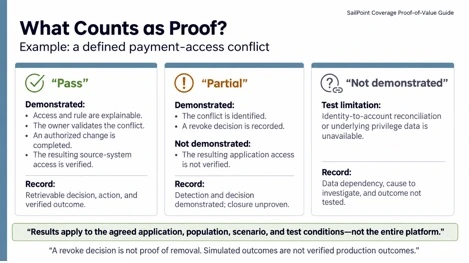
Consider the payment-access example. Suppose the test identifies a user with both privileges under the agreed SoD rule:
| Result | What happened |
|---|---|
| Pass | The access and rule are explainable; a business owner confirms the conflict; an authorized change is completed; and a later source extract confirms the unwanted access is gone. The decision and outcome are retrievable. |
| Partial | The conflict is identified and the owner selects “revoke,” but no one can confirm that access changed in the ERP application. Detection and decision were demonstrated; closure was not. |
| Not demonstrated | The team cannot reconcile the user to the application account or cannot obtain the underlying privilege data. Record the data dependency and investigate its cause before making a capability claim. |
A finding is not closed merely because someone selected “revoke.” Keep the decision, action, and verified application state separate in both the scoring and the executive readout. Your Auditors Aren´t Asking if you have SailPoint provides further context on why the evidence of a control’s operation matters more than the presence of a governance platform alone.
How should you run the test?
A four-to-six-week window is a useful planning target, subject to data access, security approvals, integration feasibility, and stakeholder availability. It is not a promise of production outcomes.
- Approve a test charter. Name the application, population, scenarios, owners, acceptance criteria, exclusions, data protections, and permitted actions.
- Collect and reconcile the baseline. Use approved SailPoint and application data from the same period. Document mismatches before treating them as capability gaps.
- Run the pre-agreed script. Apply the same control questions to the current approach and any proposed addition. Track configuration and manual work.
- Validate results with owners. Have IAM, application, security, and business stakeholders review findings, false positives, and exceptions.
- Act only where authorized. Record approved remediation, its route, and the person responsible. Do not change production access solely to complete a demonstration.
- Verify and present the result. Check the source-system state where changes were made, then present findings, limitations, dependencies, and a recommendation.
Assign an IAM or IGA lead to own the test; an application owner to explain access and authorize changes; a business or control owner to assess risk; and audit or compliance to agree what evidence is needed. Name who will settle disputed findings and who will make the final decision.
What should leadership receive?
The readout should not be a list of detected violations or screenshots of a product. It should explain what the test proved, what it did not prove, and what decision follows.
Use the same structure for each material finding:
Record the control question; population and date; result from the current process; result with the proposed addition; owner’s assessment; action and source-system verification; manual work and dependencies; unresolved limitation; and recommended decision.
| Readout field | What to record |
|---|---|
| Finding | The specific control question and observed result. |
| Cause | Missing data, configuration, access model, process, ownership, integration, or a capability not demonstrated in scope. |
| Consequence | The decision, remediation, or evidence the team cannot reliably produce today. |
| Options | A current-deployment improvement, process fix, added capability, or further test. |
| Dependency | Data, permission, integration, stakeholder time, or approval required. |
| Owner | The person accountable for the next action. |
| Decision needed | Approve a change, authorize further testing, accept a documented limitation, or close the issue. |
For example: The team detected a payment-access conflict but could not verify removal in the ERP application. The immediate issue is an unproven closure path, not necessarily a detection gap. The application owner and IAM lead must agree whether to improve the existing workflow or test an additional remediation approach; production change approval is required before closure can be demonstrated.
If SafePaaS is part of your proposed architecture, the readout should show which observed outcomes it contributed to and which still depend on SailPoint, the application, customer data, or people. That is a stronger basis for an investment decision than attributing the entire result to one tool.
Frequently asked questions
Does a gap in the test mean SailPoint failed?
No. The result applies to a defined application, population, configuration, and process. A gap may come from missing data, an implementation choice, unclear ownership, or a requirement that needs additional application-level governance.
Can we test remediation without changing live access?
You can test analysis, ownership, routing, and the proposed action path. You cannot claim verified production remediation unless an approved change is made and the resulting source state is checked. Label simulated and observed outcomes separately.
Should we choose the application with the most violations?
Not necessarily. Choose one with meaningful risk, a clear control question, available data, and owners who can validate results. The number of raw matches matters less than whether the business can explain and act on them.
What happens after the readout?
Improve the current deployment, fix ownership or process issues, test additional application-level governance, expand to another system, or close the exercise. One application’s result should guide the next decision, not become an unsupported claim about the entire estate.
Next step: Score your current governance coverage, select one critical application for a scoped POV; agree the schedule only after confirming data access, owners, permissions, and test actions. Agree on the control questions, data, owners, acceptance criteria, and decision paths before the first extract is taken. The linked scorecard assesses overall governance coverage; it is not the POV test script described in this guide.
See governance applied to the access you have today
A working session with a governance specialist — not a slide presentation.
Book your tailored demo